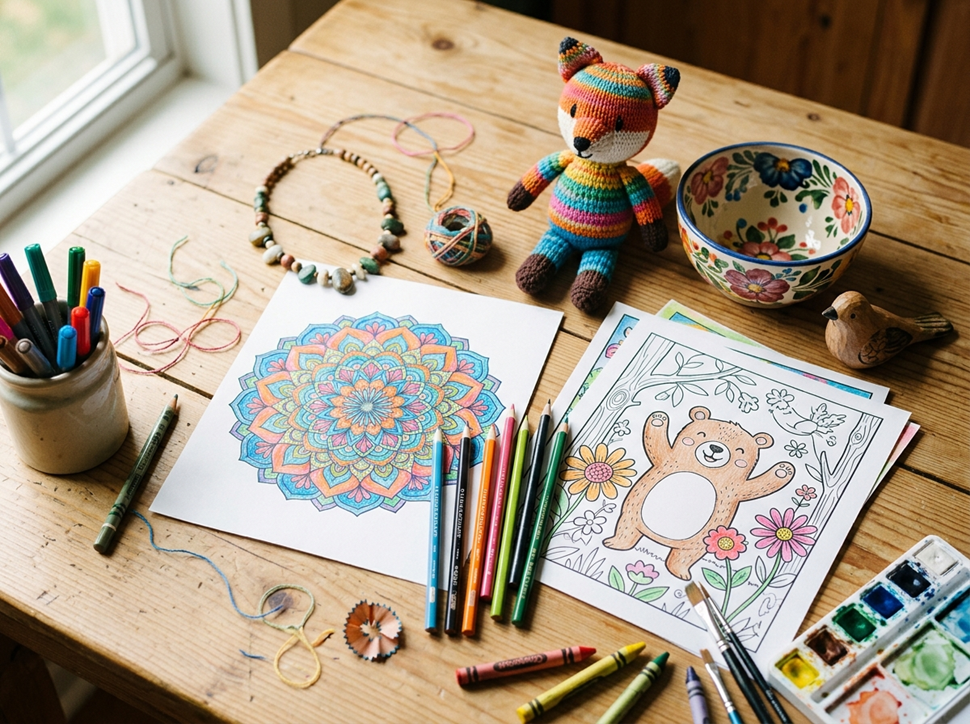
In the age of screens, passive viewing and instant gratification, the soothing and satisfying realm of active creation means more than ever. When kids put a box of crayons to coloring a picture or run wild with a messy, fun afternoon of do-it-yourself creation, they are doing a lot more than that.
They are highly developing their knowledge of the world. When coloring pages intersect with handmade crafts, and a child’s developing intelligence, it’s a fertile, scientifically supported environment. These creative activities activate neural pathways, improve problem-solving skills, develop emotional regulation and advanced cognitive development. This extensive book examines the role of colouring and making in understanding the building blocks of intelligent, resilient and imaginative children.
The Cognitive Neuroscience of Coloring Pages
At first glance, coloring inside the lines—or exploring outside of them—appears to be a simple recreational activity. However, neuroscientists and developmental psychologists view coloring as a complex neurological workout that integrates multiple brain regions simultaneously.Amazing view etc: Coloringfiles Free PDFs printables for kids.
Fine Motor Control and Visual-Spatial Processing
When a child holds a crayon, marker, or paintbrush, they are refining their fine motor skills. The intricate muscles in the fingers, hand, and wrist must coordinate with the brain to control pressure, direction, and stroke length.
- Hand-Eye Coordination: As eyes track the boundaries of a coloring page and guide the hand to stay within those lines, the visual cortex and motor cortex communicate in real-time.
- Spatial Awareness: Deciding which color goes where, understanding perspective, and recognizing geometric shapes within illustrations build foundational spatial intelligence, which later supports mathematics and geometry.
Focus, Patience, and Executive Function
Executive function refers to a suite of mental processes that enable us to plan, focus attention, remember instructions, and juggle multiple tasks successfully.
- Sustained Attention: Completing a coloring page requires a child to sit, concentrate, and see a project through from start to finish. This builds the attention span in a world of instant gratification.
- Delayed Gratification: The satisfaction of watching a blank, black-and-white outline transform into a vibrant, finished masterpiece teaches children the value of patience and persistence.
Handmade Crafts: Beyond the Scissors and Glue
While coloring pages offer a structured canvas, handmade crafts push children into the realm of open-ended engineering, design, and critical thinking. Crafting transforms abstract concepts into tangible reality.
Divergent Thinking and Problem-Solving
Crafting is rarely a straight line. A child might attempt to build a cardboard castle, only to find the walls collapsing. This creates an immediate, low-stakes engineering problem: How do I make this stand up?
- Trial and Error: Children test hypotheses—adding tape, folding paper into structural columns, or using thicker glue—and observe the results. This scientific method of inquiry builds high-level divergent thinking, teaching them that there are multiple valid solutions to a single problem.
- Resourcefulness: Using everyday items like yarn, bottle caps, and cardboard boxes encourages children to look at ordinary objects with extraordinary imagination, repurposing materials and thinking sustainably.
Mathematical and Logical Foundations
Believe it or not, the crafting table is an early mathematics classroom in disguise:
- Measurement and Geometry: Cutting paper into specific lengths, folding shapes into symmetrical origami, or measuring yarn requires intuitive understandings of geometry, fractions, and spatial metrics.
- Sequencing and Patterns: Following a multi-step craft tutorial teaches logical sequencing (“First we cut, then we fold, and finally we glue”), which mirrors algorithmic thinking and coding logic.
Emotional Intelligence (EQ) and Self-Regulation
Intelligence is not solely measured by academic metrics or logical-mathematical aptitude; emotional intelligence is equally critical for lifelong success. Creative activities provide a safe psychological harbor for emotional processing.
- Stress Reduction and Mindfulness: The repetitive motion of coloring or crafting lowers heart rates and induces a state of calm focus similar to meditation. This helps children decompress after a stimulating school day.
- Boosting Self-Efficacy: Creating something entirely from one’s own imagination and effort fosters a profound sense of competence. When a child proudly presents a handmade gift or a finished coloring page, their internal monologue shifts from “I can’t” to “I made this!”
- Frustration Tolerance: Mistakes happen in art. A crayon breaks, paint spills, or a paper cutout tears. Crafting teaches children how to pivot, adapt, and turn “mistakes” into creative design choices, building vital psychological resilience.
Language Development and Social Intelligence
Creativity is rarely a solitary endeavor, even when children work independently. It serves as a powerful catalyst for communication.
- Vocabulary Expansion: Discussing textures (“bumpy,” “smooth,” “matte”), colors (“crimson,” “teal,” “amber”), and spatial relationships (“above,” “beneath,” “adjacent”) vastly expands a child’s descriptive vocabulary.
- Cooperative Play: When children collaborate on group craft projects, they practice negotiation, sharing supplies, dividing labor, and listening to peers’ ideas. This builds collaborative intelligence and empathy.
- Etc Spring Works: Spring Coloring Pages PDF Printables
Practical Ways Parents and Educators Can Maximize Creative Benefits
To unlock the full intellectual potential of coloring and crafting, adults can shift from passive supervisors to active creative partners.
- Embrace Process Over Product: Avoid hyper-focusing on perfection. If a child colors an elephant neon green with polka dots, celebrate their creative choice rather than correcting them. The goal is expression, not replication.
- Provide Open-Ended Choices: Instead of handing over a rigid kit with only one outcome, offer a box of mixed crafting supplies—feathers, felt scraps, buttons, yarn, and paper—and pose a challenge: “Can you design an animal that has never existed before?”
- Integrate Storytelling: After a child finishes a coloring page or a craft, ask them to tell a story about it. “Who lives in this colored forest? What is the teddy bear’s adventure today?” This bridges visual art with narrative literacy.
Coloring pages and handmade crafts are far more than pleasant pastimes or rainy-day distractions. They are powerful cognitive tools that sculpt young minds, weaving together fine motor mastery, spatial reasoning, emotional regulation, and inventive problem-solving. By carving out dedicated time for these tactile, creative pursuits, we give children the greatest gift of all: the confidence to think critically, feel deeply, and imagine fearlessly.
What is your reaction to this?
 I liked it
 Wonderful
 Thanks
 Good
Good Hahaha !
 Incredible
 Interesting
 Wrong
Wrong