Explore implant-free breast aesthetics, own-tissue techniques and modern ways to reshape or enhance the breasts without conventional implants.
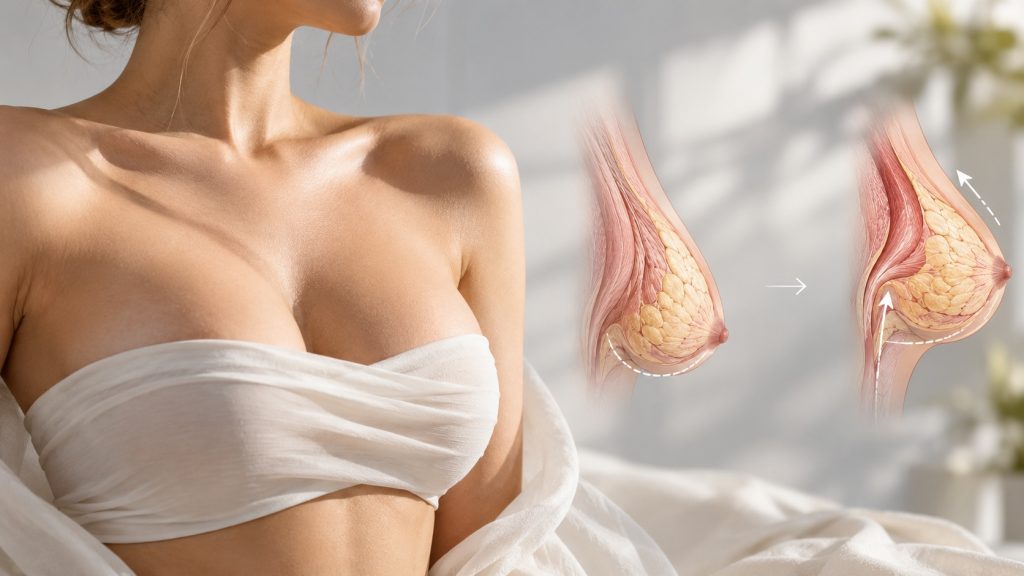
For years, breast augmentation has been closely associated with implants. That is no longer the whole picture. Some patients are less interested in adding a foreign material and instead want to know what might be achieved using tissue they already have.
That is where implant-free breast aesthetics comes in. It does not refer to one universal procedure. Rather, it covers surgical approaches that reshape, reposition or make better use of a patient’s own breast tissue. What can actually be achieved depends heavily on anatomy, existing breast volume, skin quality and, of course, the result the patient has in mind.
What Does Implant-Free Breast Aesthetics Mean?
Implant-free breast aesthetics refers to breast reshaping or enhancement without the placement of a silicone or other artificial breast implant. Depending on the technique, a surgeon may work with existing breast tissue, reposition tissue during a breast lift or use another autologous approach.
“Autologous” simply means that the tissue comes from your own body. This distinction matters. Implant-free surgery is not conventional breast augmentation with one component taken away; the surgical plan, available volume and realistic goals can all be quite different.
And one point is worth clearing up early: implant-free does not mean non-surgical. These procedures may still involve incisions, anaesthesia, recovery and the usual considerations that come with aesthetic breast surgery.
Why Are Some Patients Exploring Alternatives to Breast Implants?
There is no single reason. Some people simply prefer the idea of using their own tissue. Others begin researching breast aesthetics after pregnancy, breastfeeding, ageing or changes in weight. In those cases, the main concern may be restoring shape rather than making the breasts substantially larger.
Another common question is whether upper-pole fullness can be created without an implant. It is a useful question because a breast lift and a breast augmentation can address related concerns, but they are not the same operation and do not necessarily produce the same type of change.
People may research breast implant alternatives because they:
- Prefer the idea of using natural breast tissue rather than a foreign material
- Want to improve breast shape and position without conventional implants
- Have noticed changes in breast shape after pregnancy, breastfeeding or weight loss
- Want to explore ways of restoring upper-pole fullness
- Have concerns about implant-specific issues and future implant management
- Prefer an approach built around their existing anatomy and tissue
None of these reasons, by itself, makes someone a suitable candidate for an implant-free procedure. The amount and quality of available tissue, the degree of ptosis and the patient’s expectations still need to be assessed individually.
Can Breast Augmentation Be Performed Without Implants?
Yes, in selected patients breast contour and volume can be enhanced without a conventional breast implant. The word “augmentation”, though, needs some context. Someone looking for a dramatic increase in breast size has a very different goal from a patient who mainly wants to redistribute existing volume and regain fullness higher on the breast.
Using the Patient’s Own Tissue
One option is to reshape and strategically reposition breast tissue that is already present. No additional implant volume is introduced; the surgeon works with the patient’s own biological tissue instead.
This can be particularly relevant when there is sufficient breast volume but some of that tissue has descended. In certain techniques, tissue in the lower part of the breast does not simply have to be viewed as tissue to remove. It may become part of the reshaping plan.
Understanding Autologous Breast Enhancement
Autologous breast enhancement is a broad concept, not the name of a single operation. Put simply, it describes the use of a patient’s own tissue to contribute to breast shape or volume.
There is an obvious practical limit: the patient’s own tissue determines how much tissue is available to work with. Someone with very little breast tissue cannot necessarily achieve the same change that could be created by adding an implant. A useful consultation therefore starts with anatomy and realistic expectations rather than trying to fit every patient into a predetermined technique.
How Implant-Free Approaches Differ From Traditional Implants
A breast implant adds volume through a manufactured device. Own-tissue techniques rely on biological tissue already available to the surgeon. That basic difference affects surgical planning, potential volume, feel and the types of risks that need to be considered.
If no implant is inserted, implant-specific complications such as implant rupture or capsular contracture do not apply. Surgery itself is not risk-free, however. Scarring, asymmetry, healing problems, changes in sensation and other surgical risks still need to be discussed with a qualified surgeon.
What Is Autoprosthesis in Breast Aesthetics?
In breast aesthetics, autoprosthesis describes the idea of creating an internal supporting or volume-enhancing structure from the patient’s own tissue. Existing breast tissue is shaped and repositioned so that it can function, in effect, as a biological internal prosthesis instead of introducing an artificial implant.
One development within this field is the Autoprosthesis approach known as the Dual-Plane Autoprosthesis technique. Here, an inferior dermoglandular pedicle created from the patient’s breast tissue is repositioned into the subpectoral plane, where the pectoral muscle contributes to internal support.
The idea is more specific than simply folding tissue within the breast. Available tissue is redistributed into a different anatomical position so that it can contribute to breast shape and upper-pole projection. How much of a change this produces will naturally depend on the patient’s anatomy.
Autoprosthesis vs. Traditional Breast Implants
It is easy to turn this comparison into a question of which approach is “better”, but that misses the practical issue. They are different surgical strategies. Each has different capabilities, limitations and candidate profiles.
Source of Volume and Tissue
An implant brings additional manufactured volume into the breast. An autoprosthesis approach works by redistributing tissue the patient already has. The amount of available natural tissue therefore becomes a central part of the planning.
This is also why implant-free surgery cannot be treated as a direct replacement for implants in every case. When the primary goal is a substantial increase in breast size, the patient’s existing tissue may limit what an own-tissue approach can accomplish.
Surgical Approach
Traditional augmentation generally involves creating a pocket and positioning an implant according to the surgical plan. Autoprosthesis techniques take a different route: biological breast tissue is reshaped and repositioned, often alongside mastopexy when breast sagging is present.
The operation is therefore closely tied to the architecture of the patient’s existing breast. Tissue distribution, ptosis, the skin envelope and the desired upper-pole contour all influence how the procedure is planned.
Expectations and Limitations
Implants can add volume beyond what naturally exists. Own-tissue approaches cannot escape the simple limitation of how much usable tissue is available.
Neither approach freezes the breasts in time, either. Ageing, gravity, pregnancy, breastfeeding and significant changes in weight can continue to alter breast shape after surgery. Claims about “permanent” aesthetic results should be considered with that in mind.
What Does Noimplant Mean in Modern Breast Aesthetics?
Noimplant is a straightforward way of describing an aesthetic goal: reshaping, lifting or creating fullness in the breasts without inserting a conventional breast implant. The term overlaps with expressions such as implant-free breast augmentation, own-tissue breast aesthetics and autologous breast enhancement.
The terminology can get confusing fairly quickly. Two procedures described online as “no implant” may rely on quite different surgical methods. For a patient, the label matters less than understanding what tissue will be used, where it will be repositioned, what degree of change is realistic and what evidence supports the proposed technique.
Who May Consider Implant-Free Breast Enhancement?
No online checklist can establish whether someone is a suitable candidate. Broadly, own-tissue approaches may be worth discussing when a person has enough natural breast tissue, some degree of breast sagging and a preference for avoiding an implant.
Consider what can happen after pregnancy or a substantial change in weight. There may still be adequate breast tissue, but its distribution has changed. The breast can appear less full higher on the chest while more tissue sits lower down. In this sort of situation, redistributing existing tissue may become part of the conversation with a surgeon.
The opposite situation matters too. Someone with very little existing tissue who wants a significant increase in breast size may encounter clear limitations with an own-tissue-only approach. Photographs, diagrams and descriptions online can help explain the possibilities, but they cannot replace a physical assessment.
PureOwn and the Own-Tissue Approach to Breast Aesthetics
Readers who want to explore this particular area further can look at pureown, which focuses on implant-free breast aesthetics and the Zereyak Autoprosthesis technique developed by plastic surgeon Dr. Umut Zereyak. The approach uses an inferior dermoglandular pedicle from the patient’s own breast and positions it in the subpectoral plane to contribute to upper-pole fullness and internal support.
From an educational perspective, an interesting part of the concept is how it treats existing breast tissue as a structural resource. Instead of assuming that upper-pole volume has to come from an artificial implant, the technique considers whether a suitably selected patient has enough of her own tissue to create that effect through repositioning.
The Dual-Plane Autoprosthesis technique has also been described in peer-reviewed medical literature. Published findings about a technique, however, should never be read as a promise of the same outcome for every patient. Anatomy, patient selection, surgical planning and individual healing still influence the result.
What Should You Ask Before Choosing a Breast Aesthetic Procedure?
A consultation tends to be far more useful when the questions are specific. Instead of stopping at “Which procedure should I have?”, ask why a particular procedure is being considered for your anatomy and whether it can realistically match your expectations.
Is an Implant-Free Procedure Suitable for My Anatomy?
Ask how much usable tissue you have, where it is located and whether repositioning it could realistically produce the shape you want. If breast ptosis is present, it is also worth asking how lifting and tissue redistribution would work together.
Ask about limitations as well. Knowing what a technique cannot do can be just as useful as knowing what it can.
What Results Can Realistically Be Expected?
Words such as “natural”, “full” and “lifted” can mean different things to different people. Explain what you want to change and ask how that goal translates to your own anatomy.
Before-and-after photographs from comparable cases can provide context, but they are examples, not promises. Tissue quality, proportions and healing differ from one patient to another.
What Are the Risks, Limitations and Recovery Considerations?
Discuss scars, anaesthesia, recovery time, temporary restrictions on activity, changes in sensation, asymmetry, wound healing and the possibility of revision surgery. When comparing implants with an implant-free procedure, ask for the risks of each approach to be explained separately rather than grouped together.
Pregnancy plans, breastfeeding, future weight changes and breast screening may also be relevant to the discussion. These practical issues can matter considerably over the years, even though they receive less attention than the name of the procedure itself.
Making an Informed Decision About Implant-Free Breast Aesthetics
Growing interest in implant-free breast aesthetics gives patients more possibilities to research, but the basic principle remains fairly simple: the procedure should be chosen around the patient’s anatomy and goals, rather than trying to make the patient fit a particular procedure.
If avoiding silicone is a priority and you want to understand whether existing breast tissue could provide lift, shape or upper-pole fullness, established own-tissue techniques are worth researching. Resources focused on Implant-Free Breast Aesthetics can provide further detail on how approaches such as Dual-Plane Autoprosthesis are designed before personal suitability is discussed with a qualified plastic surgeon.
A website can explain how a technique works. It cannot determine whether that technique is appropriate for your body. That requires a detailed medical assessment of your anatomy, expectations and individual risks.
Frequently Asked Questions
Can you have breast augmentation without implants?
Yes, in selected patients. Breast enhancement can sometimes be performed using the patient’s own tissue rather than a conventional implant. How much additional volume or change in contour is possible depends on the technique and the amount of suitable tissue available.
What is an autoprosthesis in breast surgery?
An autoprosthesis is created from the patient’s own tissue and used to provide internal shape, volume or support. In breast surgery, this can involve reshaping and repositioning existing breast tissue rather than inserting a manufactured implant.
Is implant-free breast augmentation the same as a breast lift?
No, not necessarily. A breast lift mainly addresses breast position and sagging. Some implant-free techniques combine lifting with redistribution of existing tissue to influence contour or upper-pole fullness.
Can your own breast tissue create upper-pole fullness?
It can in appropriately selected patients. Certain surgical techniques reposition existing tissue toward the upper part of the breast, although the degree of fullness that can be achieved depends on anatomy and available tissue.
Does implant-free mean non-surgical?
No. An implant-free breast procedure may still require surgery, anaesthesia, incisions and a recovery period. “Implant-free” means that a conventional breast implant is not inserted.
Are implant-free breast procedures risk-free?
No. Avoiding an implant removes implant-specific complications from the equation, but it does not remove the general risks of surgery. Scarring, asymmetry, healing problems and changes in sensation are among the issues that should still be discussed.
Can implant-free surgery significantly increase breast size?
There are limits. Own-tissue techniques depend on how much usable tissue the patient already has. Someone seeking a substantial increase in size may therefore have different options from someone whose main goals are lifting, redistribution and restoring fullness.
Who may be suitable for an own-tissue breast procedure?
People with sufficient breast tissue, breast sagging or loss of upper-pole fullness who would prefer to avoid implants may be candidates for discussion. Actual suitability requires an individual medical examination.
Will breasts remain the same shape permanently after surgery?
No. Breast tissue continues to change over time. Ageing, gravity, pregnancy, breastfeeding and fluctuations in weight can all influence breast shape after surgery.
What should I compare when researching implants and implant-free options?
Look at the amount of volume you want, how much natural tissue is available, the degree of sagging, expected scars, recovery, risks and long-term expectations. Whether you are comfortable having a foreign implant is another personal consideration. A surgeon can explain how each of these factors relates to your anatomy.
How can I know whether an implant-free technique is right for me?
A physical examination is needed. A qualified plastic surgeon has to assess breast volume, tissue quality, skin, degree of ptosis, medical history and aesthetic goals before recommending a particular surgical approach.
What is your reaction to this?
 I liked it
 Wonderful
 Thanks
 Good
Good Hahaha !
 Incredible
 Interesting
 Wrong
Wrong